Startups networking meetups: SNM01 Biomedical Engineerin
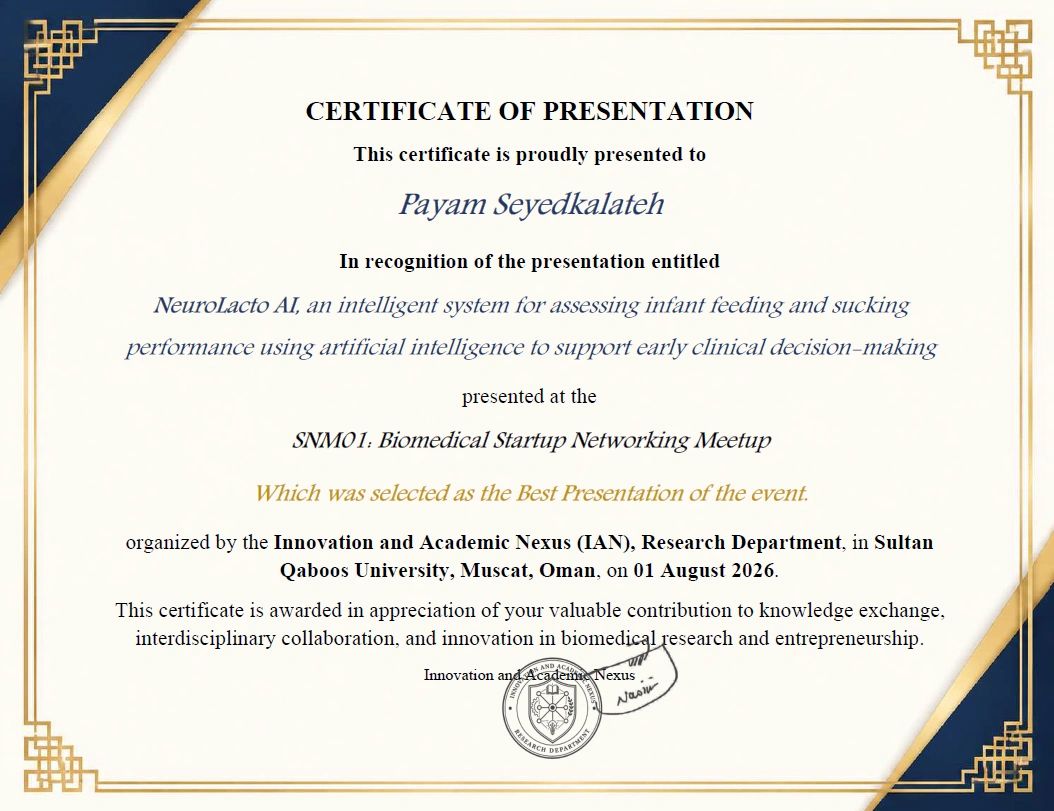

Discover the Magic of NeuroLacto
The Hemtech Program stands as one of Oman’s most prestigious national initiatives for driving innovation and supporting high-impact projects aligned with the country’s vision for a knowledge-based economy. In its previous edition, Hemtech attracted over 400 participants from across the Sultanate, with top-selected projects receiving funding support of up to 40,000 Omani Rials to accelerate development and real-world impact.
We are extremely proud to announce that NeuroLacto.AI was selected as the sole main winner of the latest Hemtech competition — the only project to secure this top position among all entries.
The selection took place during a live event at Sultan Qaboos University (SQU), where the scientific evaluation team from Al-Jabar Company carefully assessed each team’s presentation, scientific foundation, innovation, originality, and potential for societal benefit. NeuroLacto.AI was chosen as the standout winner based on the strength of our vision, the rigor of our approach, and the clear potential to transform early infant assessment and improve postnatal and breastfeeding-related care.
This achievement is a powerful validation of our team’s dedication and a major milestone in our mission to bring trustworthy, interpretable AI into neonatal and maternal healthcare.
With the support and recognition from Hemtech, we are accelerating our efforts to bring these innovations closer to clinical practice — for better outcomes for newborns and mothers in Oman and beyond.
Thank you to the Hemtech Program, Al-Jabar Company, Sultan Qaboos University, and everyone who contributed to this journey.
#NeuroLactoAI #HemtechWinner #OmanInnovation #AIinHealthcare #NeonatalCare #SQU #AlJabarCompany
Team members:
Payam Seyedkalate, Navid Nasiri, Elnaz Pooralijani

Real-Time Monitoring of Breastfeeding and Finger Sucking Pat
Abstract
Sucking and breastfeeding are essential for neonatal nutrition, providing vital nutrients that support optimal growth and immune system development. These activities also foster strong maternal-infant bonding, creating feelings of security and emotional comfort for the newborn. Furthermore, effective sucking patterns contribute to the infant's overall health, reducing risks of infections and promoting long-term well-being for both mother and child. Assessments of maternal health during pregnancy are crucial, as they reveal pre-existing conditions, nutritional status, and potential risks that could affect breastfeeding outcomes. For instance, factors like gestational diabetes, depression, or medication use can hinder breastfeeding initiation and maintenance, leading to early cessation in 30–50% of cases. Regular prenatal evaluations allow for early identification of complications, enabling timely interventions to support successful breastfeeding. Oral motor skills, including sucking and swallowing, are foundational for feeding efficiency and are closely linked to later speech and language development. Delays in these skills may signal neuromotor issues, increasing the risk of developmental vulnerabilities such as autism spectrum disorder or motor delays. Monitoring sucking patterns from birth can help detect subtle deficits that traditional subjective tools like LATCH or NOMAS often miss, with reliability estimates as low as 50–70%. In Oman, exclusive breastfeeding rates are low at 23% for the first six months, exacerbated by cultural preferences for formula feeding due to early work return and misinformation. Literature highlights the predictive value of sucking patterns: abnormal patterns correlate with developmental disorders (Yardımcı-Lokmanoğlu et al., 2024), while non-nutritive sucking matures with postmenstrual age and forecasts neurodevelopment (Martens et al., 2024; Vijay et al., 2023). Dose-response relationships show longer breastfeeding durations enhancing language skills and intelligence (Lovcevic, 2023; Oddy et al., 2011), with exclusive breastfeeding protecting against speech delays (Novayelinda et al., 2019; Dee et al., 2007). However, standardized tools for real-time sucking assessment are lacking, particularly in regions like Oman with high preterm rates (10% of births). The Smart Infant Sucking Tool (SIST) addresses this gap as a portable device measuring intraoral pressure, suck–swallow–breathe (SSB) coordination, and sucking frequency. By providing objective, real-time data, SIST enables early detection of feeding and developmental issues in primary health care settings, supporting Omani neonates and aligning with national health priorities.
Authors
Payam Seyedkalateh, Abdulrahman Al-Saadi, Elnaz Pooralijani, Hanan Saud Al-Maawali, Amna Al Futaisi, Authima Al Farsi, Navid Nasiri
NeuroLacto AI Presentation at Fursatech
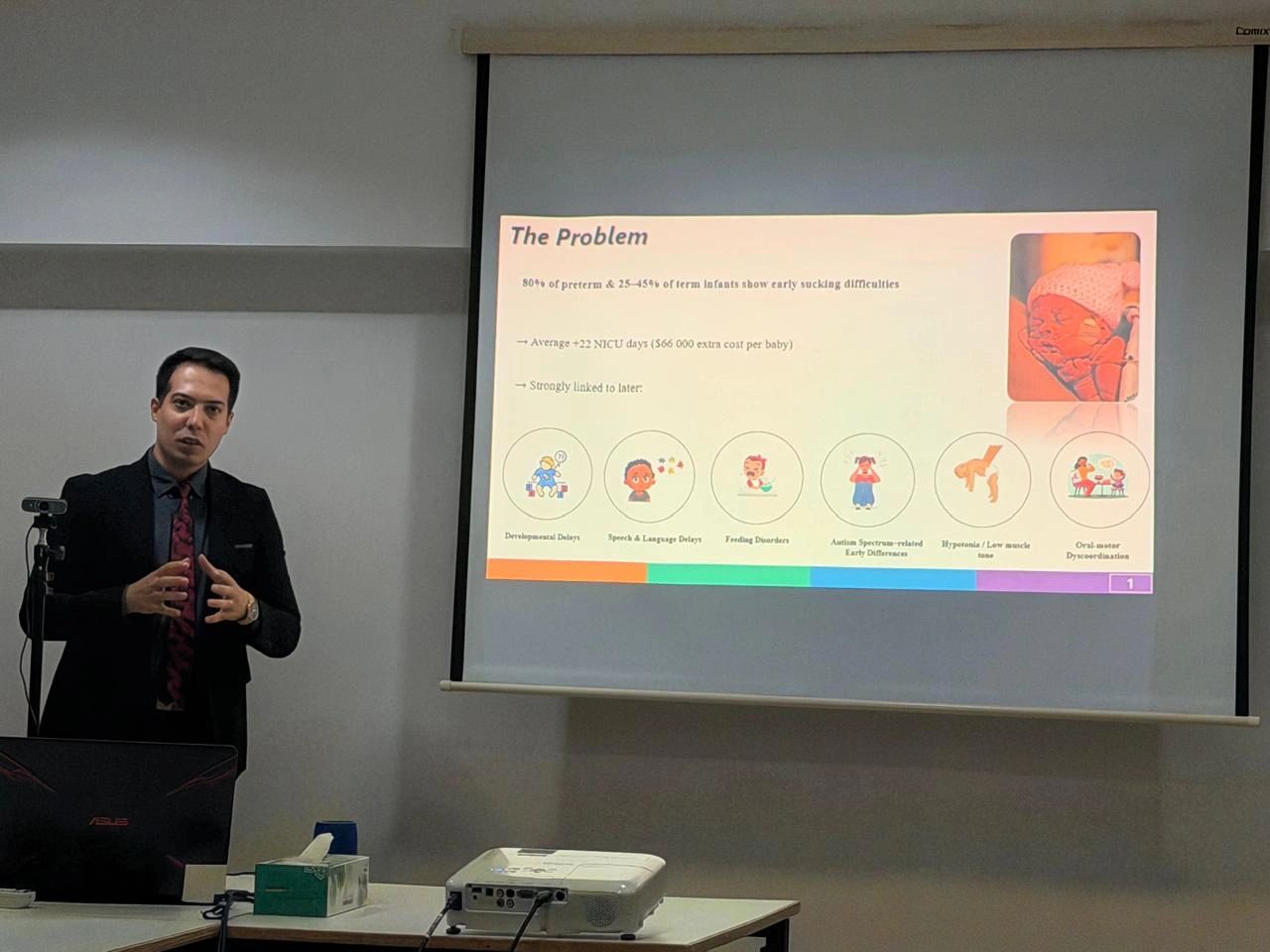
We are pleased to share that NeuroLacto AI was also presented at Fursatech, where the project was selected for presentation before the Scientific Committee.
Fursatech provided an important platform for showcasing innovative ideas and emerging technology-based solutions with strong academic, technical, and societal value. Being selected to present NeuroLacto AI to the Scientific Committee was a meaningful recognition of the project’s scientific relevance, innovation potential, and interdisciplinary strength.
At NeuroLacto AI, our work focuses on developing an AI-assisted system for infant sucking assessment to transform neonatal feeding evaluation into a more objective, data-driven, and clinically useful process. Presenting this concept at Fursatech allowed us to communicate both the engineering foundation of the system and its potential impact in maternal and neonatal healthcare.
The opportunity to discuss NeuroLacto AI in front of the Scientific Committee was especially valuable, as it reflected confidence in the project not only as a startup or innovation concept, but also as a research-based solution with meaningful future applications.
Participating in events such as Fursatech continues to strengthen our vision and motivates us to further develop NeuroLacto AI at the intersection of biomedical engineering, artificial intelligence, and clinical innovation.
We are grateful for the opportunity to share our work and for the recognition received through this selection.
Team members:
Payam Seyedkalate, Navid Nasiri, Elnaz Pooralijani
29.10.2025
A Pilot Study of Developing an Infant Sucking Tester Instrum
Abstract
Objectives: Most preterm infants experience oral feeding disorder. Sucking is the most appropriate way for oral feeding, but it may be immature in preterm infants. Regarding the increased risk of feeding problems in preterm infants, investigating and monitoring their sucking patterns to present appropriate and timely intervention is recommended. The current research aimed to report the design of an instrument for measuring the suction pressure in preterm infants through a pilot study. We also checked the validity and reliability of the instrument. Methods: A pilot study was conducted to measure the validity and reliability of this instrument. First, the instrument was developed, and in the next step, discriminant validity, test-retest reliability, and comparison in terms of sex were investigated by measuring the suction pressure of 20 full-term and 15 preterm infants. The Mann-Whitney U test and Wilcoxon test were used to assess discriminant validity, sex-based comparisons, and test-retest reliability in SPSS v. 23. Results: Two groups showed a significant difference in the suction pressure (P<0.001) to support the discriminant validity of the instrument. We obtained satisfactory test-retest reliability in two groups (r=0.97, P<0.001). Boys and girls did not significantly differ between full-term (P=0.9) and preterm infant groups (P=0.5). Discussion: Performing the pilot study on 35 infants through an infant sucker tester proved the instrument’s discriminant validity and test-retest reliability. However, conducting the studies with a larger sample size is essential to make this instrument available commercially.
Authors
Mehdi Dehghan, Payam Seyedkalateh, Zahra Akbarian-Rad, Mohsen Haghshenas Mojaveri, Soraya Khafri, Akram Ahmadi