Feeding Problems as an Indicator of Developmental Delay ...
... in Early Childhood - PubMed
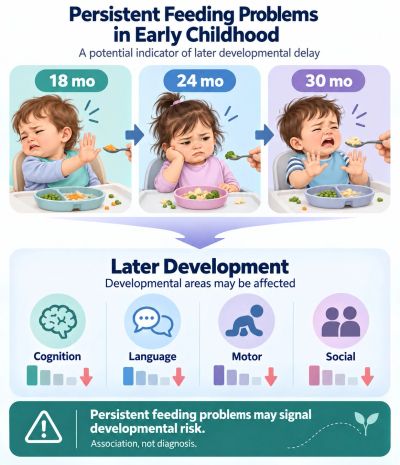
This prospective longitudinal cohort study investigated whether persistent feeding problems during early childhood could serve as an indicator of later developmental delay. The study followed 3,597 children and assessed feeding difficulties and developmental outcomes at 18, 24, and 30 months of age, with a subset of children receiving a more comprehensive developmental assessment at 4 years.
The findings showed that feeding problems were consistently associated with developmental difficulties across multiple domains. As the number of feeding problems increased, the likelihood of developmental delay also increased. Children with a persistently high number of feeding problems across several assessment periods were more than four times as likely to show delays across developmental domains compared with children who experienced few or no feeding problems.
The association became stronger when feeding difficulties persisted over time. At 30 months, higher levels of feeding problems were also associated with lower developmental scores at 4 years across multiple domains, suggesting that persistent difficulties with feeding may provide clinically relevant information about a child’s broader developmental trajectory.
Overall, the study highlights feeding behavior as an observable aspect of early childhood development that may help identify children who could benefit from closer developmental monitoring. Although feeding problems are not specific to developmental delay and the study does not establish a causal relationship, persistent feeding difficulties may represent an important early clinical signal when considered alongside other developmental and neurological indicators.
Breastfeeding patterns in infants are associated with a later diagnosis of autism spectrum disorder
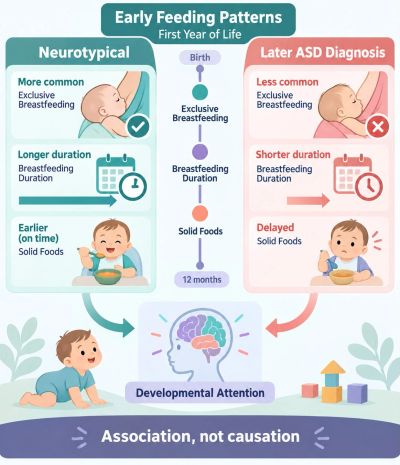
This retrospective case-control study investigated whether feeding patterns during the first year of life were associated with a later diagnosis of autism spectrum disorder (ASD). The study included 270 children diagnosed with ASD and 500 neurotypical children, with researchers examining early breastfeeding practices, breastfeeding duration, and the timing of complementary food introduction.
The findings showed that children later diagnosed with ASD had different early feeding patterns compared with neurotypical children. Exclusive breastfeeding and longer breastfeeding duration were less common among children later diagnosed with ASD, while delayed introduction of solid foods was more frequently observed. These differences suggest that early feeding behaviors may be associated with later neurodevelopmental characteristics.
The study highlights the potential value of early feeding history as one component of understanding developmental trajectories. Feeding behaviors during infancy are influenced by multiple factors, including oral-motor development, sensory processing, maternal–infant interaction, and neurological maturation. Therefore, differences in early feeding patterns may provide clinically relevant information when considered alongside other developmental indicators.
Overall, the findings support the importance of monitoring early feeding behaviors as part of a broader approach to early neurodevelopmental assessment. However, because this was a retrospective observational study, the associations identified do not establish that breastfeeding or the timing of complementary feeding directly influences the development of ASD. Instead, the results reinforce the potential role of early feeding characteristics as observable markers that may warrant further developmental attention.
Feeding and developmental outcomes after neonatal seizures—A prospective observational study
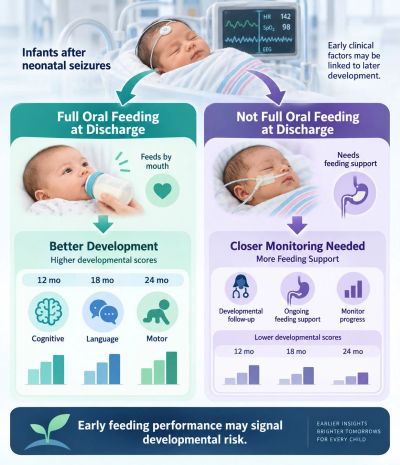
This prospective multicenter study investigated whether early oral feeding ability could provide an early indicator of later neurodevelopmental outcomes in infants who experienced acute symptomatic neonatal seizures. The researchers followed 276 infants from nine centers and examined their ability to achieve full oral feeding at hospital discharge, together with developmental outcomes at 12, 18, and 24 months of corrected age.
The findings showed that infants who were unable to achieve full oral feeding at discharge had significantly lower developmental scores at 12, 18, and 24 months compared with infants who achieved full oral feeding. At 24 months, the mean WIDEA-FS developmental score was substantially lower among infants who had not achieved full oral feeding (121.8 vs. 160.2), indicating a strong association between early feeding ability and subsequent developmental functioning.
The study also found that inability to achieve full oral feeding was associated with greater long-term feeding support needs. Among infants who did not achieve full oral feeding at discharge, nearly half required gastrostomy feeding at 12 months, compared with only 1% of infants who were fully orally fed at discharge. Importantly, the association between feeding status and developmental outcomes remained significant after adjustment for other clinical factors, supporting the value of early feeding performance as an objective clinical marker of developmental risk.
Overall, the study highlights that early feeding performance may provide clinically meaningful information about an infant’s neurological and developmental status. Although the study population consisted of infants with acute symptomatic neonatal seizures and therefore the findings cannot be generalized to all healthy newborns, the results support the broader concept that early feeding behaviors can serve as observable indicators of underlying neurological function and may help identify infants who could benefit from closer developmental monitoring and early intervention.
[8]. https://doi.org/10.1002/cns3.6Digital Object Identifier (DOI)
Infant Feeding and Weight Gain: Separating Breast Milk From Breastfeeding and Formula From Food
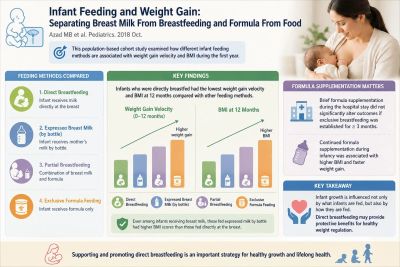
This population-based cohort study investigated how different infant feeding methods were associated with weight gain and body mass index during the first year of life. Rather than examining breastfeeding as a single category, the researchers distinguished between direct breastfeeding, feeding expressed breast milk by bottle, partial breastfeeding, and exclusive formula feeding.
The findings showed that infants who were directly breastfed had lower weight gain velocity and lower BMI scores at 12 months compared with infants receiving other feeding methods. Even among infants receiving breast milk, those fed expressed milk by bottle showed higher BMI scores than those fed directly at the breast. Partial breastfeeding and exclusive formula feeding were associated with progressively greater increases in weight gain and BMI.
The study also found that brief formula supplementation during the hospital stay did not significantly alter outcomes if exclusive breastfeeding was later successfully established for at least three months. However, continued formula supplementation during infancy was associated with higher BMI and faster weight gain.
Overall, the study highlights that infant growth outcomes are influenced not only by what infants are fed, but also by how they are fed. These findings suggest that direct breastfeeding may provide protective benefits for healthy weight regulation, reinforcing the importance of supporting effective breastfeeding practices during early infancy.
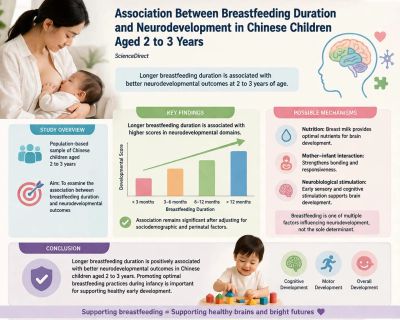
Association between breastfeeding duration and neurodevelopment in Chinese children aged 2 to 3 years
This study investigated the association between breastfeeding duration and neurodevelopmental outcomes in children aged 2 to 3 years in a Chinese population-based sample. The aim was to examine whether the length of breastfeeding in early life is linked to later cognitive, motor, and overall developmental performance during early childhood.
The findings showed that longer breastfeeding duration was generally associated with better neurodevelopmental outcomes at 2 to 3 years of age. Children who were breastfed for extended periods demonstrated higher scores in developmental assessments compared to those with shorter breastfeeding durations. This association remained significant even after adjusting for several sociodemographic and perinatal factors.
The study also suggested that breastfeeding duration may act as an important early-life exposure influencing brain development, possibly through mechanisms related to nutrition, mother–infant interaction, and early sensory and neurobiological stimulation. However, the study emphasized that breastfeeding is likely one of multiple contributing factors to neurodevelopment rather than a sole determinant.
Overall, the findings support the idea that longer breastfeeding duration is positively associated with early childhood neurodevelopment, reinforcing the importance of promoting optimal breastfeeding practices during infancy as part of broader strategies for supporting healthy developmental outcomes.
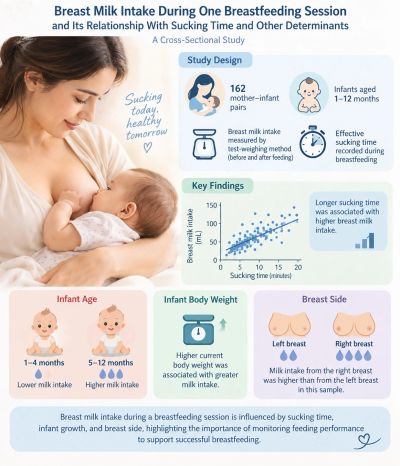
Relationship of breast milk intake during one breastfeeding session with sucking time and other determinants: a cross-sectional study
This cross-sectional study examined how much breast milk infants receive during a single breastfeeding session and how this intake is related to sucking time and other maternal or infant factors.
The researchers studied 162 mother–infant pairs with infants aged 1 to 12 months. During breastfeeding, they recorded the infant’s effective sucking time and measured breast milk intake using the test-weighing method, which compares infant weight before and after feeding.
The findings showed a significant positive relationship between sucking time and breast milk intake. In other words, infants who spent more time effectively sucking during a feeding session generally consumed more milk. The study also found that current infant body weight and the breast side used for feeding were important determinants of milk intake during one breastfeeding session.
The researchers reported that milk intake from the right breast was higher than from the left breast in their sample. They also found that infants aged 5–12 months had a higher average milk intake rate than infants aged 1–4 months, suggesting that feeding efficiency may improve as infants mature.
Overall, the study highlights that breast milk intake during breastfeeding is influenced not only by feeding duration, but also by infant growth and feeding-side factors. The findings support the value of monitoring effective sucking time and breastfeeding performance to better understand milk transfer, guide breastfeeding support, and identify mothers or infants who may need additional feeding assessment..
Nipple Pain and its Characteristics During the Breastfeeding Process: A Longitudinal Brazilian Study
This prospective longitudinal study investigated the occurrence, intensity, and progression of nipple pain among breastfeeding mothers over time in the postpartum period. Mothers were followed across different stages of breastfeeding to evaluate how nipple pain develops and changes as feeding becomes established.
The findings showed that nipple pain was most frequent and intense during the early days after birth, particularly in the first weeks of breastfeeding, and gradually decreased as lactation progressed. Pain characteristics varied across mothers but were strongly associated with breastfeeding technique, latch quality, and early adaptation to feeding.
Mothers who experienced persistent or higher-intensity nipple pain were more likely to report breastfeeding difficulties and were at increased risk of interrupting exclusive breastfeeding earlier than recommended. In contrast, improvement in latch and feeding mechanics was associated with reduced pain and more successful continuation of breastfeeding.
Overall, the study highlights that early identification and management of nipple pain are critical for supporting breastfeeding continuation, improving maternal comfort, and promoting optimal feeding outcomes for infants. These findings reinforce the importance of early functional assessment of breastfeeding behavior and mother–infant feeding coordination.

Breastfeeding pattern and its relationship with weight gain in children older than 6 months
This case–control study investigated the relationship between breastfeeding patterns and weight gain in infants aged 6–24 months. The researchers compared 120 infants from health centers in Ahvaz, Iran, including 60 children with normal growth and 60 with delayed growth, to examine whether specific breastfeeding behaviors were associated with growth problems.
The findings showed that demographic factors such as infant age, sex, maternal age, educational level, socioeconomic status, type of delivery, maternal opinion about breastfeeding cessation, and the interval between breastfeeding and complementary feeding were not significantly associated with growth disorder. In contrast, shorter breastfeeding duration per meal and frequent breastfeeding dependency on the mother’s breast were significantly related to growth problems in children older than 6 months.
The study suggests that after 6 months of age, inappropriate breastfeeding patterns may contribute to insufficient weight gain, particularly when breastfeeding is very frequent but feeding sessions are too short or when complementary feeding may not adequately meet the child’s increasing nutritional needs.
Overall, the study highlights that in infants older than 6 months, growth outcomes are influenced not only by whether breastfeeding continues, but also by how breastfeeding is practiced alongside complementary feeding. These findings emphasize the importance of appropriate feeding patterns and parental guidance to support healthy growth and development.
Feeding Behaviors in Infants and Toddlers Later Diagnosed with Autism Spectrum Disorder: A Systematic Review
This systematic review examined early feeding behaviors in infants and toddlers who were later diagnosed with autism spectrum disorder (ASD), with the aim of identifying feeding-related markers that may appear before formal diagnosis. The study analyzed evidence from multiple longitudinal and observational investigations focusing on breastfeeding patterns, introduction of complementary feeding, and early oral-motor feeding responses.
The findings showed that infants later diagnosed with ASD more frequently demonstrated atypical early feeding characteristics, including shorter breastfeeding duration, delayed transition to solid foods, reduced feeding flexibility, and unusual sensory responses during feeding. Differences in early feeding regulation and responsiveness to hunger and satiety cues were also reported across several studies.
Importantly, these feeding differences often appeared during the first year of life—well before behavioral diagnostic criteria for ASD are typically met. This suggests that feeding behavior may reflect early alterations in sensory processing, motor coordination, and caregiver–infant interaction patterns associated with neurodevelopmental vulnerability.
Overall, the study highlights that early feeding behaviors may serve as observable developmental indicators of later neurodevelopmental differences, supporting the role of structured feeding assessment as part of early screening strategies for infants at risk of autism spectrum disorder.
Feeding-Related Early Signs of Autism Spectrum Disorder: A Narrative Review
This narrative review explored how early feeding milestones and oral-motor behaviors may function as early indicators of neurodevelopmental differences associated with autism spectrum disorder. The study examined breastfeeding patterns, transition to complementary feeding, sensory responses to food textures, and early regulation of feeding behavior during infancy.
The findings showed that infants later diagnosed with ASD often demonstrate early deviations in feeding development, including reduced breastfeeding persistence, delayed acceptance of complementary foods, atypical oral sensory responses, and difficulties adapting to new textures and feeding routines. Alterations in hunger regulation and feeding interaction patterns between caregivers and infants were also frequently reported.
These feeding differences were interpreted as early manifestations of underlying variations in sensory processing, motor coordination, and social engagement—domains closely linked to emerging neurodevelopment. Such deviations may appear months or years before formal diagnostic identification.
Overall, the study highlights that monitoring early feeding milestones can contribute to earlier recognition of neurodevelopmental risk patterns and supports the inclusion of structured feeding observation within early developmental screening frameworks. .