
Why Artificial Intelligence Is Transforming Infant Feeding
Artificial Intelligence (AI) has become one of the most influential technologies in modern healthcare. From medical imaging and disease diagnosis to personalized treatment planning, AI is helping clinicians process large amounts of complex information more efficiently and consistently. While much of the public attention has focused on applications such as cancer detection or medical imaging, AI also has enormous potential in areas that have traditionally relied on human observation—one of which is infant feeding assessment.
Assessing how an infant feeds is a fundamental part of neonatal and pediatric care. Healthy feeding requires precise coordination between sucking, swallowing, and breathing, all of which develop rapidly during the first weeks and months of life. Difficulties in this coordination may indicate feeding disorders, oral-motor dysfunction, or developmental immaturity. Detecting these challenges early can improve clinical outcomes and support timely intervention.
Today, most feeding assessments depend on the experience of healthcare professionals. Clinicians observe the infant, evaluate sucking rhythm, swallowing, endurance, and overall feeding behavior, and then make informed clinical decisions. Although this approach has served neonatal care for decades, it is inherently subjective. The same feeding session may be interpreted differently by different clinicians, and subtle patterns that develop over time may not be easily recognized.
Artificial Intelligence offers a new way to approach this challenge.
Rather than replacing healthcare professionals, AI can assist them by identifying patterns within physiological data that are difficult to recognize through visual observation alone. When infant sucking behavior is recorded using appropriate sensing technologies, it generates a continuous stream of physiological information. These signals contain details about pressure, rhythm, timing, consistency, and feeding dynamics that are often too complex for manual analysis.
Machine learning algorithms are designed to learn from this type of data. Instead of relying on manually defined rules, they examine thousands of examples and discover relationships between signal characteristics and clinical outcomes. As more high-quality data becomes available, these models gradually improve their ability to recognize meaningful patterns and support clinical decision-making.
One of AI's greatest strengths is consistency. Unlike human observers, AI applies the same analytical process every time a signal is evaluated. This consistency can reduce variability between assessments and provide clinicians with standardized quantitative information that complements their professional judgment.
Another important advantage is the ability to analyze multiple variables simultaneously. A clinician may naturally focus on a few observable characteristics during a feeding session, whereas an AI model can evaluate dozens or even hundreds of signal features at once. These may include sucking pressure, cycle duration, burst organization, variability, temporal intervals, and frequency characteristics. By considering all of these measurements together, AI may detect subtle combinations of features that would otherwise remain unnoticed.
It is important to recognize, however, that AI is not intended to make medical decisions independently. Clinical expertise remains essential. The role of AI is to function as a decision-support tool by providing objective analysis and highlighting patterns that deserve closer attention. Final diagnosis and treatment decisions should always remain in the hands of qualified healthcare professionals.
Developing reliable AI systems for neonatal healthcare also requires careful engineering. High-quality sensors, robust signal processing, accurate data labeling, and clinically validated datasets are all essential components. Without reliable data, even the most advanced algorithms cannot produce meaningful results. Therefore, successful AI solutions depend on close collaboration between engineers, clinicians, researchers, and healthcare institutions.
At NeuroLacto AI, we believe that artificial intelligence should enhance—not replace—clinical practice. Our vision is to combine biomedical sensing, physiological signal processing, and interpretable machine learning to create an objective and practical tool for infant feeding assessment. By transforming complex sucking signals into clinically meaningful insights, AI has the potential to improve consistency, support early detection of feeding difficulties, and contribute to better neonatal care.
The future of infant feeding assessment is not defined by artificial intelligence alone. Rather, it lies in the partnership between experienced clinicians and intelligent technologies, working together to provide more accurate, data-driven, and personalized care for every infant.
Author
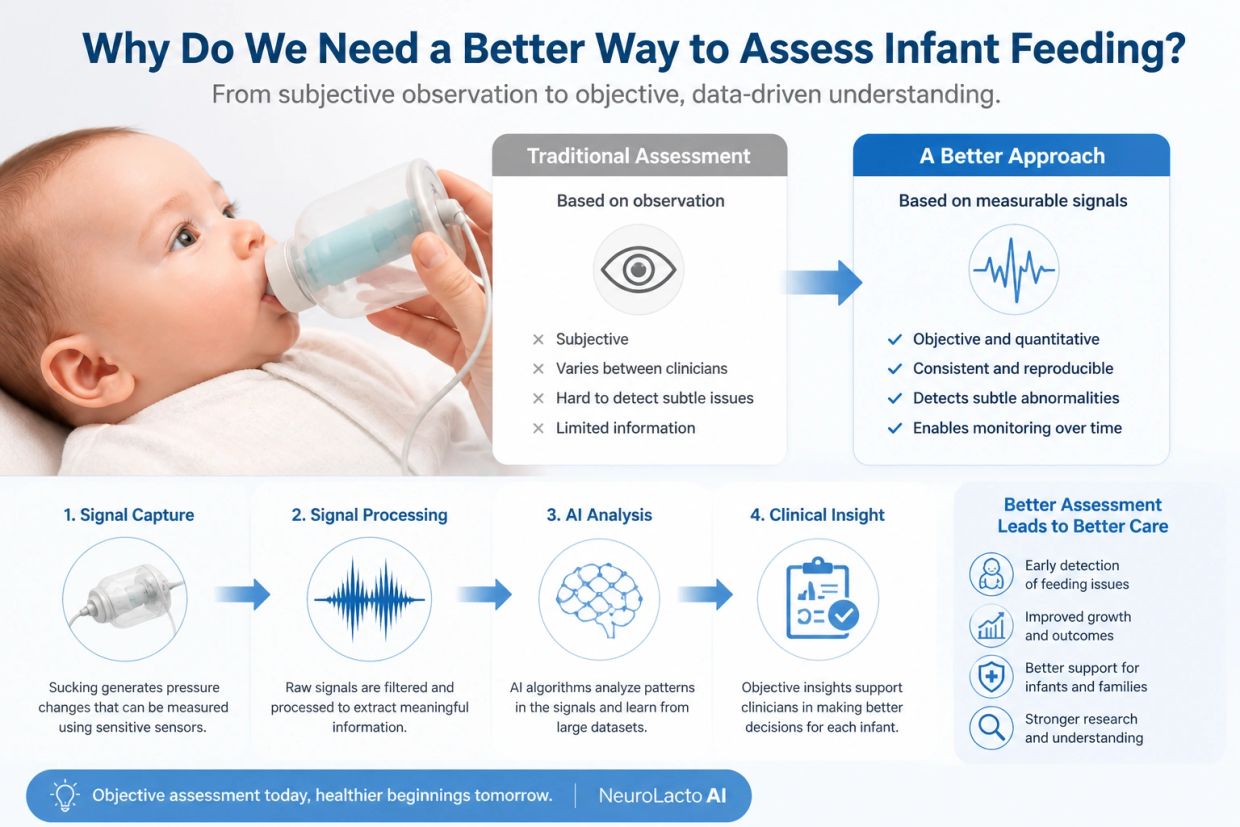
Why Do We Need a Better Way to Assess Infant Feeding?
Introduction
Infant feeding is one of the earliest and most critical functions in human development. In the first days and weeks of life, successful feeding is not only essential for nutrition and growth, but also reflects the coordination of multiple physiological systems, including neurological control, oral-motor function, and respiratory stability. Despite its importance, the assessment of infant feeding—especially sucking behavior—remains largely subjective in many clinical settings.
Traditionally, clinicians evaluate feeding by observing the infant during breastfeeding or bottle-feeding. They look for signs such as latch quality, sucking rhythm, swallowing coordination, endurance, and overall comfort. While these observations are valuable and often based on years of clinical experience, they are inherently qualitative. Two clinicians may interpret the same feeding behavior differently, and subtle abnormalities may go unnoticed, particularly in early stages.
This subjectivity becomes even more critical in neonatal care, especially for preterm or medically vulnerable infants. In such cases, early identification of feeding difficulties can play a significant role in preventing complications, supporting proper growth, and reducing hospital stay. However, without objective measurement tools, clinicians must rely on indirect signs, which may not fully capture the underlying physiological processes.
One of the key challenges lies in the nature of sucking itself. Sucking is not a simple repetitive motion—it is a dynamic, rhythmic process that involves pressure generation, timing coordination, and interaction with swallowing and breathing. These components are difficult to quantify through observation alone. For example, it is challenging to precisely measure how strong a baby’s sucking pressure is, how consistent the rhythm remains over time, or how feeding patterns change during fatigue.
From an engineering perspective, this gap suggests the need for objective, signal-based assessment methods. If feeding behavior can be measured as a physiological signal, then it becomes possible to analyze it quantitatively. Advances in biomedical sensing technologies now allow the capture of intraoral pressure, sucking cycles, and temporal feeding patterns. These measurements can provide a more detailed and reproducible understanding of infant feeding performance.
However, capturing data is only the first step. The complexity of biological signals requires careful interpretation. A raw signal alone does not directly indicate whether feeding is normal or problematic. This is where computational methods, particularly artificial intelligence, begin to play an important role. By analyzing patterns across multiple features—such as pressure amplitude, frequency, and rhythm—AI models can assist in identifying meaningful trends that may not be immediately visible.
The integration of engineering and clinical knowledge has the potential to transform how infant feeding is assessed. Instead of relying solely on observation, clinicians could benefit from supportive tools that provide quantitative insights, improve consistency, and enable early detection of abnormalities. This does not replace clinical expertise, but rather enhances it by providing an additional layer of objective information.
Moreover, a better assessment approach opens new opportunities beyond diagnosis. It can support longitudinal monitoring, allowing caregivers and clinicians to track an infant’s development over time. It can also contribute to research by providing standardized data across populations, helping to better understand feeding patterns and their relationship with health outcomes.
At NeuroLacto AI, this challenge is at the core of our work. We believe that infant feeding assessment can evolve from a largely subjective practice into a more data-driven, interpretable, and clinically meaningful process. By combining sensing technologies, signal processing, and intelligent analysis, it becomes possible to uncover patterns that were previously hidden within complex biological behavior.
In summary, the need for a better way to assess infant feeding arises from three key limitations: subjectivity, lack of quantification, and difficulty in capturing subtle physiological signals. Addressing these challenges through engineering and AI-driven approaches represents an important step toward improving neonatal care and supporting early-life health.
Author
FROM SUCKING TO SIGNALS: HOW INFANT FEEDING CAN BE MEASURED
Introduction
Feeding in early infancy is often seen as a natural and automatic process. However, from a physiological and engineering perspective, infant feeding is a highly coordinated biomechanical activity that reflects the interaction of multiple systems in the body. Every successful feed depends on the infant’s ability to generate rhythmic sucking pressure, coordinate swallowing, maintain breathing stability, and sustain organized oral-motor behavior over time. When any part of this process is immature or disrupted, feeding difficulties may appear.
This is why infant sucking behavior has attracted increasing attention in neonatal and pediatric research. Sucking is not simply a feeding action; it can also act as a functional indicator of oral-motor development, neurological maturity, and feeding readiness. In clinical settings, especially in neonatal intensive care units (NICUs), clinicians often evaluate feeding based on direct observation. They look for signs such as latch quality, sucking rhythm, endurance, swallowing coordination, and physiological stability. While this approach is valuable, it is also subjective and highly dependent on the experience of the clinician.
From an engineering point of view, this raises an important question: can sucking be measured objectively?
The answer is yes.
When an infant sucks, the mouth generates pressure changes and repetitive movement patterns. These physiological events can be captured as signals using appropriate sensing technologies. In practical terms, a feeding or sucking event can be transformed into a time-series waveform, where each peak and trough corresponds to pressure generation, oral compression, or rhythmic sucking cycles. Once this signal is recorded, it becomes possible to analyze feeding behavior quantitatively rather than relying only on visual judgment.
This is where biomedical engineering becomes highly relevant. A sensing system can be designed to capture infant sucking activity through pressure-based or motion-based methods. For example, a pressure sensor embedded in a pacifier, feeding interface, or clinical measurement tool can record changes in intraoral vacuum or compression forces during sucking. Similarly, signal acquisition electronics can digitize the analog pressure pattern and convert it into a clean waveform for analysis. In some emerging systems, even video-based methods are being explored to estimate subtle facial and jaw movements associated with non-nutritive sucking.
Once the raw signal is obtained, the next step is signal processing. Raw physiological signals are rarely clean enough for direct interpretation. They often contain baseline drift, movement artifacts, environmental noise, or irregular fluctuations. Therefore, preprocessing methods such as filtering, normalization, smoothing, or event segmentation are needed before meaningful interpretation can begin.
After preprocessing, the signal can be translated into measurable features. These may include:
- Amplitude, which reflects how strongly the infant generates sucking pressure
- Frequency, which describes how fast sucking cycles occur
- Burst structure, showing how sucks are grouped over time
- Rhythmicity, which reflects the consistency and organization of the sucking pattern
- Temporal intervals, such as pauses between sucks or between bursts
These features are important because they help convert a biological behavior into structured data. Instead of saying “the baby seems to suck weakly”, one can describe the feeding pattern with measurable parameters such as lower peak pressure, irregular cycle timing, or reduced burst duration.
This shift from observation to quantification is important in both research and clinical applications. Objective signal-based measurement may support earlier detection of feeding problems, improve consistency across assessments, and help monitor developmental progress over time. It may also provide a way to compare nutritive and non-nutritive sucking behavior under standardized conditions.
However, measuring infant feeding is not only about sensors and waveforms. The real challenge lies in interpreting what those signals mean. Two infants may produce different patterns for many reasons, including gestational age, neurological maturity, fatigue, oral structure, respiratory coordination, or clinical condition. Therefore, engineering alone is not enough; the signal must be interpreted in a physiologically meaningful way.
This is exactly where intelligent data analysis becomes useful. Once enough high-quality sucking data is collected, computational models can begin to recognize patterns that may not be obvious to the human eye. In this sense, infant feeding assessment moves from a simple mechanical recording problem into a broader field involving biomedical instrumentation, physiological signal processing, and eventually artificial intelligence.
In other words, sucking can be measured because it is not just a behavior — it is also a signal. And once a biological function becomes a signal, engineering provides the tools to capture it, analyze it, and potentially transform it into clinically useful insight.
For NeuroLacto.ai, this idea forms the foundation of a larger vision: turning subtle infant feeding behavior into measurable, interpretable, and actionable data.