Standardization of sucking patterns during breastfeeding in healthy term neonates
A cross-sectional study
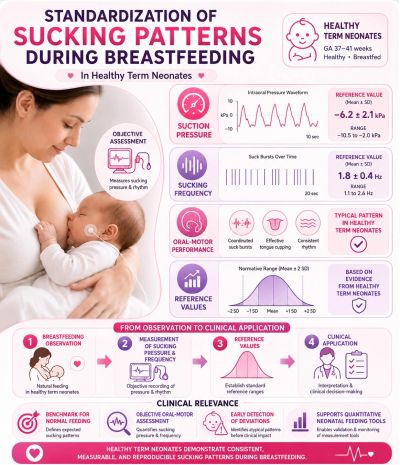
This cross-sectional study established normative characteristics of sucking patterns during breastfeeding in healthy full-term newborns. The researchers evaluated sucking pressure and sucking frequency to define reference values that characterize normal breastfeeding behavior in the early neonatal period.
The findings demonstrated that healthy term infants exhibit consistent and measurable sucking patterns, including reproducible ranges of suction pressure and sucking frequency during breastfeeding. These normative data provide objective benchmarks for evaluating oral-motor performance and identifying deviations from typical feeding behavior.
The authors suggest that standardized assessment of sucking characteristics may improve the early detection of feeding difficulties and support more objective clinical evaluation of infant oral-motor function. Establishing normal reference values may also facilitate the development of quantitative assessment tools for neonatal feeding.
Overall, the study highlights the importance of defining normal sucking characteristics in healthy newborns, providing a valuable foundation for objective assessment of infant sucking patterns and early identification of feeding disorders.
An Examination of the Association Between Infant Non-Nutritive Suck and Developmental Outcomes at 12
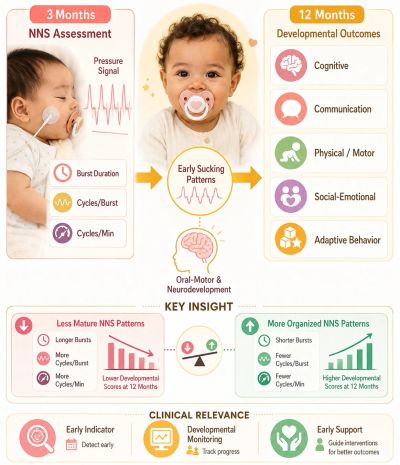
This longitudinal study investigated whether non-nutritive sucking (NNS) patterns at 3 months of age are associated with developmental outcomes at 12 months in healthy full-term infants. NNS refers to sucking without milk transfer, such as sucking on a pacifier.
The researchers assessed NNS using a pressure-sensing pacifier and examined measures including burst duration, cycles per burst, cycles per minute, sucking amplitude, and number of bursts. Development at 12 months was evaluated using the Developmental Profile–3, covering cognitive, communication, social-emotional, physical, and adaptive behavior domains.
The findings showed that less mature NNS patterns at 3 months—particularly longer sucking bursts, more cycles per burst, and more cycles per minute—were associated with lower cognitive and overall developmental scores at 12 months. In contrast, infants with more organized and developmentally mature sucking patterns tended to show stronger later developmental functioning.
Overall, the study suggests that early NNS dynamics may provide a non-invasive window into infant neurodevelopment. Objective assessment of sucking patterns could help identify infants who may benefit from closer developmental monitoring or early supportive intervention.
Early sucking and swallowing problems as predictors of neurodevelopmental outcome in children with..
... neonatal brain injury: a systematic
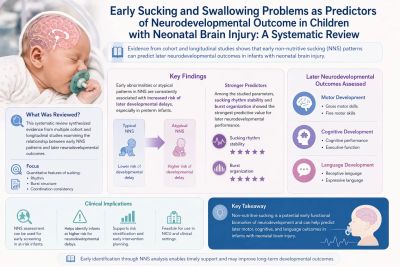
This systematic review synthesized evidence from multiple cohort and longitudinal studies examining the relationship between non-nutritive sucking (NNS) patterns and later neurodevelopmental outcomes, including motor, cognitive, and language development. The analysis focused on quantitative features of sucking such as rhythm, burst structure, and coordination consistency.
The findings showed that early abnormalities or atypical patterns in NNS are consistently associated with increased risk of later developmental delays, particularly in preterm infants. Among the studied parameters, sucking rhythm stability and burst organization demonstrated the strongest predictive value for later neurodevelopmental performance.
Overall, the review highlights that non-nutritive sucking can serve as a potential early functional biomarker of neurodevelopment, supporting its use in early screening and risk stratification in both clinical and NICU setting.
[8] jacinta douglas, “Jacinta Douglas - La Trobe University.” Accessed: Apr. 21, 2026. [Online].
Geometric and topological constraints on oral seal formation during infant breastfeeding
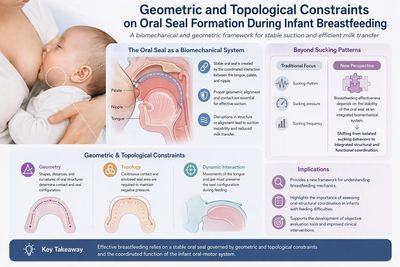
This study introduced a novel biomechanical and geometric model to analyze oral seal formation during infant breastfeeding, focusing on the structural and spatial conditions required for stable suction. Unlike traditional approaches that mainly examine sucking rhythm, pressure, or frequency, this work emphasized the global configuration of the oral cavity and the dynamic interaction between the tongue, palate, and nipple.
The findings suggest that breastfeeding effectiveness is not determined solely by sucking patterns, but is strongly dependent on the stability of the oral seal as a coordinated biomechanical system. Disruptions in the spatial alignment of oral structures were shown to lead to reduced suction efficiency and feeding instability.
Overall, the study proposes a new conceptual framework for understanding breastfeeding mechanics, shifting the focus from isolated sucking behaviors toward integrated structural and functional coordination within the infant oral-motor system. These findings provide important implications for improving the assessment of feeding difficulties and advancing objective evaluation of breastfeeding performance..
Relationships of breast milk intake during one breastfeeding session with sucking time and other ...
... determinants: a cross-sectional study
This cross-sectional study investigated the facto associated with the amount of breast milk intake during a single breastfeeding session. Mother–infant pairs were assessed to determine how infant sucking behavior and selected maternal and infant characteristics influenced milk transfer during feeding.
The findings showed that sucking time was significantly associated with breast milk intake, with infants who spent longer actively sucking generally receiving greater volumes of milk. Infant weight was also identified as a contributing factor, suggesting that infant size and feeding capacity may influence feeding efficiency during breastfeeding sessions.
In contrast, most maternal characteristics, including age, body mass index, and parity, were not significantly associated with the amount of milk intake during the observed feed. These results indicate that immediate feeding dynamics may be more strongly influenced by infant feeding behavior than by maternal demographic factors alone.
Overall, the study highlights that infant sucking performance, particularly the duration of effective sucking, plays an important role in determining breastfeeding efficiency and milk transfer. These findings support the value of objective assessment of sucking behavior in identifying feeding effectiveness and optimizing breastfeeding support in the early.

The association between infant non-nutritive suck and oral motor development
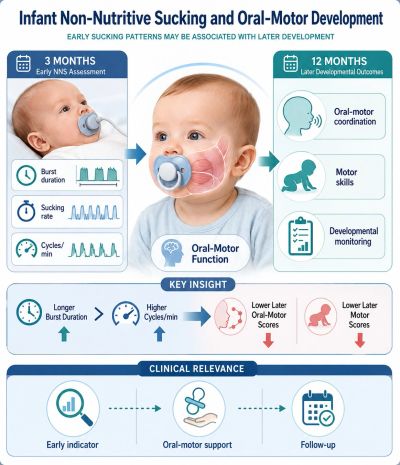
This study examined whether non-nutritive sucking (NNS) patterns at 3 months of age are associated with later oral-motor and motor development at 12 months. NNS refers to sucking without milk transfer, such as sucking on a pacifier, thumb, or an empty breast.
The researchers followed 69 full-term infants. At 3 months, NNS was measured using a pressure-sensing pacifier to assess characteristics such as burst duration, sucking rate, and number of suck cycles. At 12 months, caregivers completed the Child Oral and Motor Proficiency Scale (ChOMPS), which evaluates oral-motor coordination and broader motor skills.
The findings showed that infants with longer NNS burst durations tended to have lower oral-motor coordination scores and lower overall ChOMPS scores at 12 months. In addition, a higher number of sucking cycles per minute was associated with lower complex motor movement scores.
Overall, the study suggests that early NNS patterns may reflect aspects of later oral-motor and motor development. Measuring the organization and quality of infant sucking may therefore provide a useful early indicator for identifying infants who could benefit from closer developmental monitoring or targeted oral-motor support.
Longitudinal changes in infant non-nutritive sucking across the first year of life
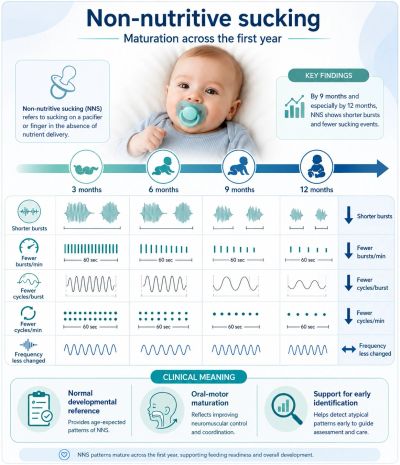
This prospective longitudinal study examined how non-nutritive sucking (NNS) develops across the first year of life in healthy full-term infants. NNS refers to sucking without milk transfer, such as sucking on a pacifier, and is an early oral-motor behavior linked to feeding development and neurodevelopmental function.
Twenty-four full-term infants were assessed at 3, 6, 9, and 12 months of age. During each session, infants sucked on a custom pacifier equipped with a pressure transducer, allowing researchers to measure burst duration, sucking frequency, pressure amplitude, number of bursts per minute, cycles per burst, and total cycles per minute.
The findings showed that NNS patterns changed significantly as infants matured. By 9 months, infants demonstrated shorter sucking bursts, fewer bursts per minute, fewer cycles per burst, and fewer cycles per minute. These reductions became even more pronounced by 12 months, indicating continued maturation and reorganization of sucking behavior across the first year.
Importantly, sucking frequency did not show the same clear developmental change as the other NNS measures. This suggests that maturation is reflected more strongly in the overall organization, duration, and efficiency of sucking bursts than in frequency alone.
Overall, the study provides developmental reference information for understanding how NNS normally evolves during infancy. Such longitudinal data may help clinicians distinguish expected maturation from atypical sucking patterns and support earlier identification of infants who may benefit from further feeding or oral-motor assessment.
Are sucking patterns and early spontaneous movements related to later developmental functioning ....
Outcomes? A Cohort Study
This cohort study examined whether early sucking patterns and spontaneous infant movements are associated with later developmental functioning in infants considered at risk for developmental difficulties.
The researchers assessed sucking quality using the Neonatal Oral Motor Assessment Scale (NOMAS) from 34 weeks’ postmenstrual age to 10 weeks after term age. They also evaluated fidgety movements and overall movement quality using the General Movements Assessment (GMA) between 9 and 20 weeks after term age. Later cognitive, language, and motor outcomes were measured with the Bayley Scales of Infant and Toddler Development–III between 12 and 42 months of age.
The findings showed that sucking patterns, fidgety movements, and Motor Optimality Score–Revised (MOS-R) were all related to later cognitive, language, and motor development. Infants with abnormal sucking patterns, atypical spontaneous movements, or lower movement-optimality scores were more likely to show poorer developmental functioning later in childhood.
The study also found that early spontaneous movement assessment had stronger predictive value than sucking assessment alone. However, combining both oral-motor and movement-based measures provided a broader picture of an infant’s early neurodevelopmental status.
Overall, the study highlights the value of early, non-invasive developmental assessment. Evaluating both sucking quality and spontaneous movements may help clinicians identify infants who could benefit from closer developmental monitoring and earlier intervention..

Nutritive and non-nutritive sucking patterns associated with pacifier use and bottle-feeding in ...
Full-Term Infants
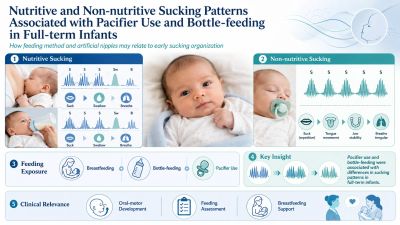
This study examined whether pacifier use and bottle-feeding are associated with differences in nutritive and non-nutritive sucking patterns among healthy full-term infants. The researchers focused on early sucking organization, including the rhythm and coordination of sucking behaviors during feeding and non-feeding situations.
The findings suggested that exposure to artificial nipples, including pacifiers and bottles, was associated with changes in infant sucking patterns. These differences were observed in both nutritive sucking, which involves milk transfer during feeding, and non-nutritive sucking, such as pacifier sucking without milk intake.
The study highlights that early oral experiences may influence how infants organize sucking movements. Because sucking requires coordination of the lips, tongue, jaw, swallowing, and breathing, variations in these patterns may be clinically relevant wwhen assessing early feeding development.
Overall, the authors concluded that pacifier use and bottle-feeding may be associated with measurable differences in sucking behavior in full-term infants. The findings support the importance of considering feeding method and artificial nipple exposure when evaluating infant oral-motor function and early feeding patterns.
Subtle Signals: Video-based Detection of Infant Non-nutritive Sucking as a Neurodevelopmental Cue
This study explored whether ordinary baby-monitor videos could be used to detect infant non-nutritive sucking (NNS) without attaching sensors or relying on time-intensive bedside observation. NNS—sucking on a pacifier, finger, or similar object without milk transfer—can provide useful information about early feeding readiness and neurodevelopmental function.
The researchers developed a computer-vision approach that analyzes subtle facial and jaw movements in video footage. Using optical-flow features and temporal deep-learning models, the system classified short video clips as either NNS or non-NNS and then combined these results to identify NNS episodes within longer recordings.
The work introduced annotated infant-video datasets, including clinical overnight baby-monitor footage from 19 infants totaling 183 hours. This enabled the team to test whether NNS could be identified in natural, real-world settings rather than only through specialized pressure-sensing pacifiers or direct clinical observation.
Overall, the study demonstrates the potential of video-based, contact-free NNS monitoring as a more accessible and scalable method for infant assessment. By enabling objective identification of sucking activity from routine video recordings, this approach may support future research and clinical tools for developmental monitoring, feeding assessment, and early identification of infants who may need further evaluation.