Infant Pigs Demonstrate Motor Adaptation Across Multiple Physiologic Functions ...
.... During Feeding in Response to Dynamic Changes in Milk Flow Rate
Maressa E Kennedy , Elska B Kaczmarek, Ani E Smith, et al.
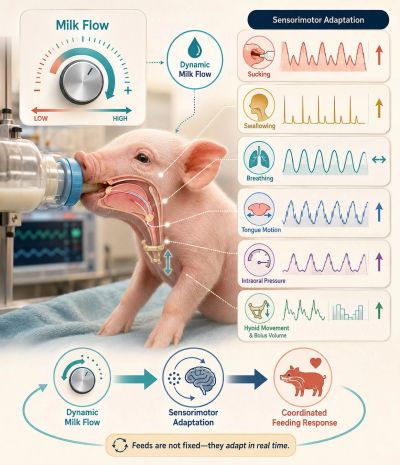
This experimental study investigated how the infant feeding system adapts to changes in sensory input during feeding. Using an infant pig model, researchers dynamically altered milk flow rate during feeding and simultaneously assessed sucking, swallowing, respiratory patterns, intraoral pressure, and tongue and hyoid–thyroid movements.
The findings demonstrated that changes in milk flow produced coordinated adaptations across multiple feeding behaviors. Although sucking rate remained relatively stable, changes in flow significantly affected intraoral pressure, tongue movements, swallow frequency, bolus volume, and hyoid–thyroid movement. The timing and coordination of swallowing and breathing also changed in response to variations in milk flow.
These findings suggest that infant feeding is not generated by a fixed motor pattern alone. Instead, sucking, swallowing, and breathing are continuously adjusted through sensory feedback, allowing the developing feeding system to respond to changes in the physical environment.
Importantly, the study provides evidence for the role of sensorimotor integration in infant feeding, demonstrating how sensory information related to milk flow can modify motor output in real time. This adaptive capacity may be particularly important during early development, when neural circuits controlling feeding are still maturing.
Overall, the study highlights that effective infant feeding depends on dynamic interactions between sensory input, neural control, and coordinated motor responses. Understanding these adaptive mechanisms may provide important insights into normal feeding development and the neurophysiological basis of feeding difficulties..
Differences in the Swallowing Process of Newborns and Healthy Preterm Infants: First Results with ..
.... a Non-Invasive Bioimpedance and Electromyography Measurement System
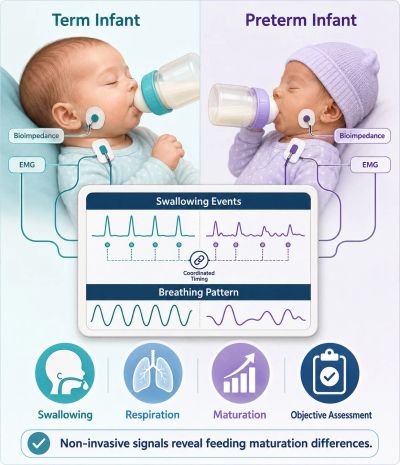
This study investigated the physiological characteristics of swallowing in healthy newborn and preterm infants using a novel non-invasive measurement system combining bioimpedance and electromyography. The researchers aimed to determine whether differences in swallowing and respiratory patterns could be objectively detected between term and preterm infants during feeding.
The findings demonstrated measurable differences in the swallowing process between newborn and preterm infants. The non-invasive system was able to detect pharyngeal swallowing events and respiratory activity during feeding, providing objective information about the temporal relationship between these physiological processes.
The results highlight that swallowing is not an isolated motor event, but a highly coordinated physiological process involving the pharyngeal muscles, respiratory system, and underlying neural control mechanisms. Differences observed in preterm infants may reflect the ongoing maturation of the neural and sensorimotor systems responsible for safe and efficient feeding.
Importantly, the study demonstrates the potential of non-invasive bioimpedance and electromyography for objectively assessing infant swallowing physiology during natural feeding conditions. Such quantitative approaches may help improve the understanding of feeding maturation and identify atypical swallowing patterns at an early stage.
Overall, the study highlights the value of combining physiological signal monitoring with clinical feeding assessment to better understand the neurophysiological development of swallowing in infancy. These findings support the growing role of objective, non-invasive technologies in the assessment of infant feeding and the early identification of immature or atypical feeding patterns.
[9] Differences in the swallowing process of newborns and healthy preterm infants: first results with a non-invasive bioimpedance and electromyography measurement system
The multifunctionality of the brainstem breathing control circuit
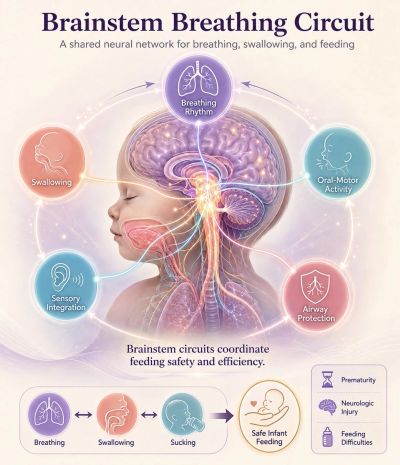
This review explores the neural circuitry within the brainstem that generates and regulates breathing and explains how these respiratory networks interact with other vital behaviors, including feeding and swallowing. Recent advances in molecular neuroscience have revealed that brainstem respiratory circuits are not limited to controlling breathing alone but also coordinate multiple complex physiological functions.
The authors describe how specialized neuronal populations within the brainstem integrate sensory information and synchronize respiratory rhythms with oral motor activities such as sucking and swallowing. This coordination is essential for maintaining airway protection and ensuring safe, efficient feeding during early life.
This review also highlights how modern genetic and neurophysiological techniques have transformed the understanding of brainstem function, providing new insights into the neural mechanisms underlying infant feeding and respiratory control.
Overall, the study emphasizes that feeding is fundamentally a brainstem-mediated neurophysiological process, in which breathing, swallowing, and oral motor behaviors are tightly integrated through shared neural circuits. These findings provide an important foundation for understanding both normal feeding development and disorders affecting early feeding coordination.
Development of eating skills in infants and toddlers from a neuropediatric perspective
Hermann Kalhoff et al. Ital J Pediatr. 2024.
This review examines the development of feeding and eating skills from infancy through early childhood from a neuropediatric perspective. The authors describe how feeding abilities evolve through the maturation of neural, sensory, and motor systems, progressing from reflexive sucking in early infancy to more complex skills such as chewing, swallowing, and self-feeding.
The review highlights that successful feeding development depends on the coordinated maturation of the central nervous system, oral-motor function, sensory processing, and postural control. As infants grow, feeding behaviors become increasingly sophisticated, reflecting the development of higher neural networks involved in motor planning and sensorimotor integration.
The authors also discuss how disruptions in neurological development can affect feeding skills and may contribute to feeding disorders, delayed oral-motor development, and nutritional challenges. Early recognition of atypical feeding patterns may therefore provide important insights into underlying neurodevelopmental conditions.
Overall, the review emphasizes that feeding development is closely linked to brain maturation and neurological function. Understanding the neurodevelopmental foundations of feeding skills can support earlier identification of developmental concerns and guide targeted interventions during infancy and early childhood.
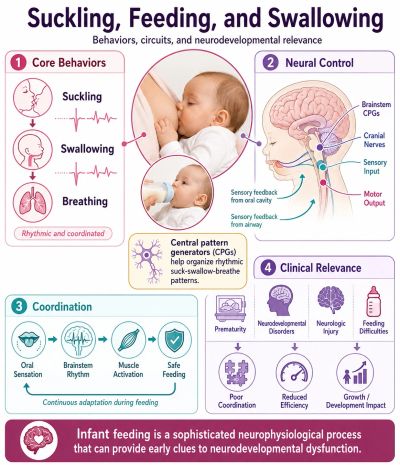
Suckling, Feeding, and Swallowing: Behaviors, Circuits, and Targets for Neurodevelopmental Pathology
This review explores the neurobiological mechanisms underlying infant feeding, focusing on the neural circuits that control suckling, swallowing, and feeding behaviors during early development. The authors describe how feeding is regulated by complex interactions between the brainstem, cranial nerves, sensory pathways, and motor control networks that must function in a highly coordinated manner to support safe and effective nutrition.
The review highlights the role of central pattern generators (CPGs) in the brainstem, which produce the rhythmic motor patterns required for sucking, swallowing, and breathing. These neural networks integrate sensory feedback from the oral cavity and upper airway, allowing infants to continuously adapt feeding behavior to changing physiological demands.
The authors also discuss how disruptions in these neural circuits can contribute to feeding difficulties in infants with neurodevelopmental disorders, prematurity, or neurological injury. Alterations in the coordination of feeding-related neural pathways may impair feeding efficiency, growth, and developmental outcomes.
Overall, the review demonstrates that infant feeding is a highly sophisticated neurophysiological process governed by specialized neural circuits. Understanding the neural control of suckling and swallowing provides important insights into the early identification of feeding disorders and the development of objective neurodevelopmental biomarkers.
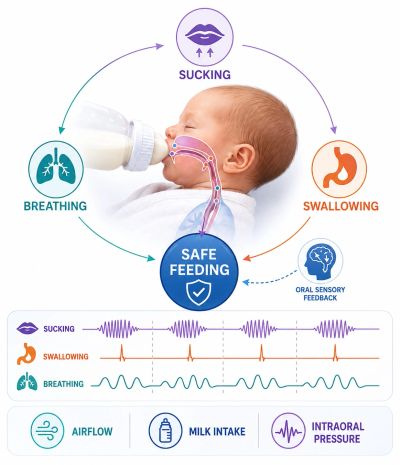
Relationship to infant feeding
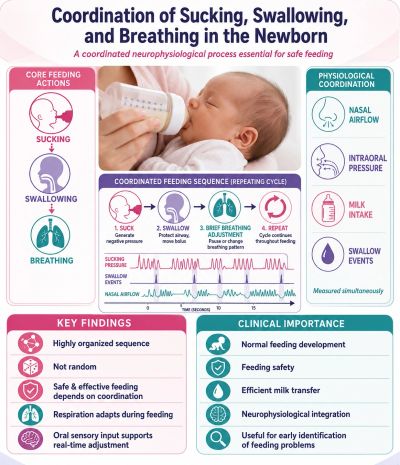
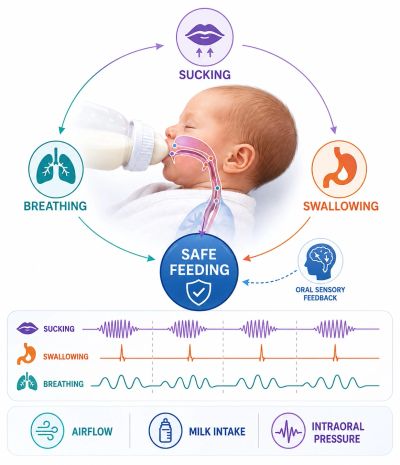
This study investigated the physiological coordination of sucking, swallowing, and breathing in full-term newborns during feeding. Using non-invasive recording techniques, researchers simultaneously measured nasal airflow, milk intake, intraoral pressure, and swallowing events under controlled feeding conditions.
The findings demonstrated that infant feeding follows a highly organized and coordinated sequence of events, rather than a random process. The coordination between sucking, swallowing, and breathing was shown to be essential for safe and effective feeding.
The study also found that respiratory patterns during feeding differ from normal breathing, adapting specifically to accommodate milk intake. Sensory input from the oral cavity played a key role in regulating this coordination, helping the infant adjust feeding behavior in real time.
Overall, the results highlight that infant feeding is a complex neurophysiological process requiring precise integration of multiple systems, and that proper coordination is critical for normal feeding development.
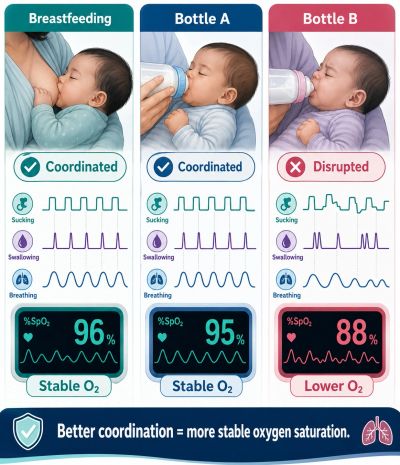
Oxygen saturation
This prospective study examined how the coordination of sucking, swallowing, and breathing affects oxygen saturation in infants during breastfeeding and bottle-feeding. Infants were first breastfed and then bottle-fed with expressed breast milk using two different bottle systems.
The findings showed that during breastfeeding, swallowing occurred in a well-organized, non-random pattern between breaths, allowing breathing to remain stable. A similar coordinated pattern was observed with one bottle system, while the other showed more random swallowing and disrupted coordination.
Infants with less coordinated feeding patterns demonstrated greater breathing instability and lower oxygen saturation levels. In contrast, more physiologic coordination was associated with more stable oxygen levels.
Overall, the study highlights that effective feeding depends on precise coordination between sucking, swallowing, and breathing, and that disruptions in this coordination can directly impact respiratory stability and feeding safety.
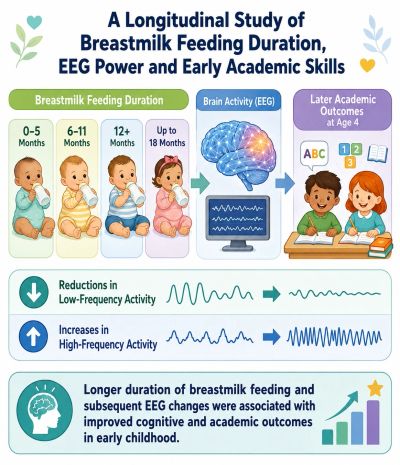
A longitudinal study of breastmilk feeding duration, EEG power and early academic skills
This longitudinal study investigated the relationship between the duration of breastmilk feeding, brain activity, and later cognitive outcomes. Infants were followed from early life, with feeding patterns recorded up to 18 months, while brain activity was measured using EEG. Early academic skills, including language, numeracy, and general knowledge, were later assessed at age four.
The findings showed that longer durations of breastmilk feeding—particularly beyond 12 months—were associated with measurable changes in EEG activity, reflecting more mature brain function. These neurophysiological changes were, in turn, linked to better performance in early academic skills.
Specifically, reductions in low-frequency brain activity (such as delta and theta waves) and increases in higher-frequency activity were associated with improved cognitive outcomes, suggesting more advanced neural maturation.
Overall, the study highlights that early feeding experiences can influence brain development at a neurophysiological level, which may have lasting effects on cognitive and academic outcomes.
Effect of Infant Feeding Type on Auditory Event-Related Potentials at 24 Months
This study examined how early feeding type influences brain function by measuring auditory event-related potentials (ERPs) at 24 months of age. Infants were followed longitudinally and grouped based on their feeding type during infancy, including breast milk and different types of formula.
The findings showed that feeding type was associated with measurable differences in neural responses related to auditory and language processing. Specifically, variations were observed in ERP components such as amplitude and latency, reflecting differences in how the brain processes sound and speech-related stimuli.
Infants exposed to different feeding patterns demonstrated distinct neural activity profiles, suggesting that early nutritional and feeding experiences can influence the development of neural pathways involved in language and cognitive functions.
Overall, the study highlights that infant feeding is not only a nutritional process but also plays a significant role in shaping early brain function and neurodevelopment.
Optimizing infant neuroimaging methods to understand the neurodevelopmental impacts of early nutriti
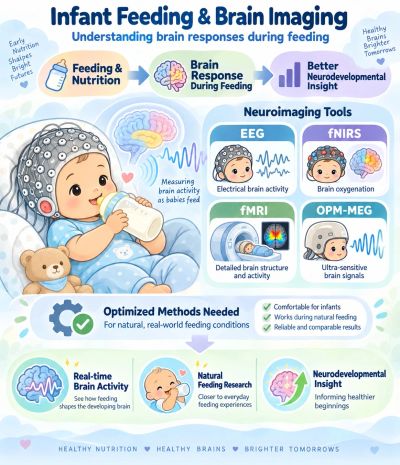
This review explores how advanced neuroimaging techniques can be used to better understand the impact of early nutrition and feeding on infant brain development. The authors highlight that while previous research has linked feeding and nutrition to structural brain changes, there is still limited knowledge about real-time brain activity during feeding.
The study discusses the use of modern neuroimaging tools such as EEG and fNIRS, as well as emerging methods like fMRI and OPM-MEG, which allow for more detailed and dynamic assessment of neural activity during feeding. These technologies provide new opportunities to measure how the infant brain responds to feeding in real time.
The authors also address current methodological challenges and emphasize the need for optimized protocols to accurately capture neural activity during natural feeding conditions.
Overall, the study highlights that understanding brain function during feeding is a critical missing piece in neonatal research, and that advanced neuroimaging can provide deeper insights into how early feeding experiences shape neurodevelopment.